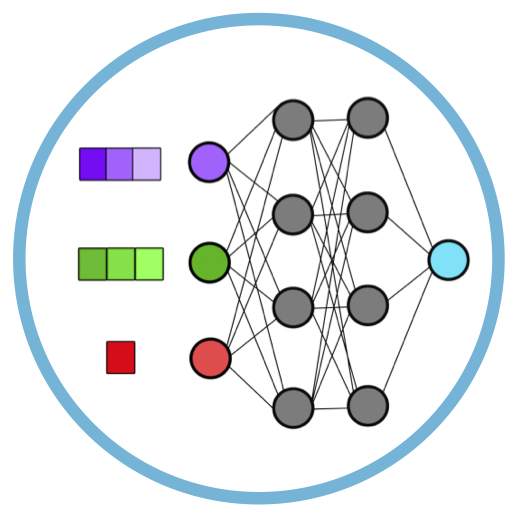
Equivariant Neural Networks
Encoding physical symmetries has shown to be a promising avenue towards more accurate, physics-aware machine learning models. In particular, capturing the equivariant, rather than just invariant, behavior of molecular systems, has lead to the next generation of force fields. In this space, I have worked on a number of different advancements. One such example are ionic liquids, an important class of systems for battery electrolyte materials. In addition, I have explored new multi-modal learning frameworks that seamlessly incorporate thermodynamics into different classes of machine learning models, including equivariant neural networks. Finally, I have spent time exploring efficiency improvements using NVIDIA’s cuEquivariance package, as well as implementing new batching strategies for enhanced sampling.
Code available soon
Publications: https://arxiv.org/pdf/2405.19386 https://pubs.acs.org/doi/abs/10.1021/acs.jpclett.4c01942
Coarse Grained Force Fields
Molecular dynamics is an essential in the study of dynamics for many complex systems. However, systems with a large number of degrees of freedom, as well as those containing long time-scale processes such as protein folding, can quickly become inaccesible with traditional techniques. A popular approach to overcome these difficulties is to “coarse grain” a system to a latent space representation, effectively freezing out fast degrees of freedom. I’m interested in using machine learning techniques to develop force fields for these latent space systems.
Code available soon
Publications: https://www.nature.com/articles/s41524-023-01183-5 https://arxiv.org/pdf/2405.19386
Small Molecule Solubility
The solubility of compounds in different solvents is a critical property in numerous applications. These can be used to examine the relative behavior of biological small molecules in aqueous versus organic liquid environments found in the body. Alternatively, solubility is important for studying gas absorption for gas storage applications. We aim to explore novel ways of accurately and efficiently predicting the solubility of small gas molecules in systems where Widom insertion techniques are a viable approach.
Code available soon
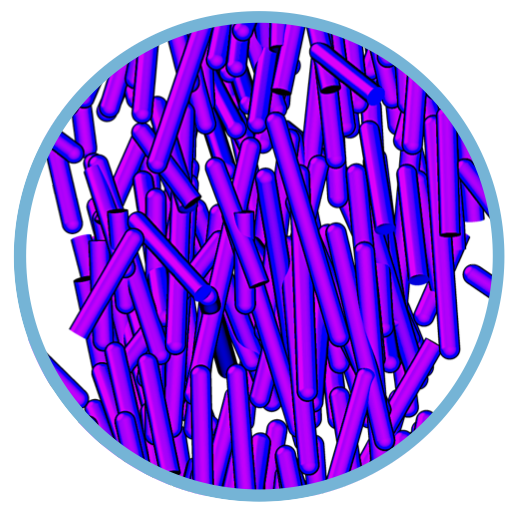
Mesophases of Liquid Crystal Elastomers
Research into soft matter materials is sure to advance the state-of-the-art in applications such as artificial tissue. One example of particularly promising soft matter materials are liquid crystal elastomers (LCE), which are networks of long, rigid molecules linked together by other molecules. The linkers in the network can lead to the emergence of different mesophases in unique ways. Using molecular dynamics along with experimental insights, we aim to explore how these choices impact the phase diagrams of LCE systems in addition to the impact of different choices in force fields.
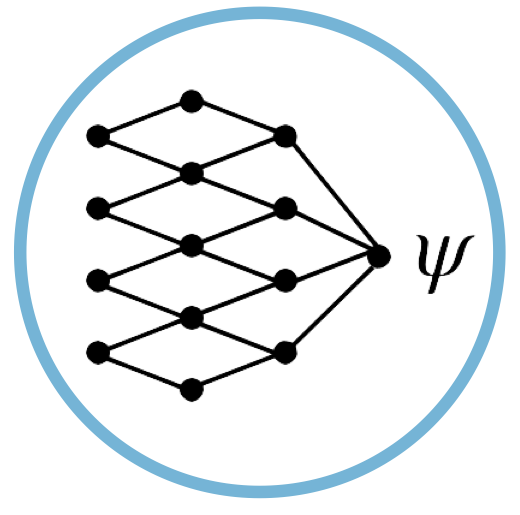
Machine Learning Exchange Correlation Functionals
Density functional theory (DFT) is one of the primary tools for studying quantum systems. The utility of the theory lies in the off-loading of complicated non-local interaction information of an electronic system into the so-called exchange correlation energy functional. Numerous approximations to this quantity exist, but none are sufficient to accurately describe the physics of strongly correlated systems or Van der Waals materials. Recent advances in machine learning suggest that it is possible to learn complex functionals that may be better suited to study these non-traditional systems within the DFT formalism.
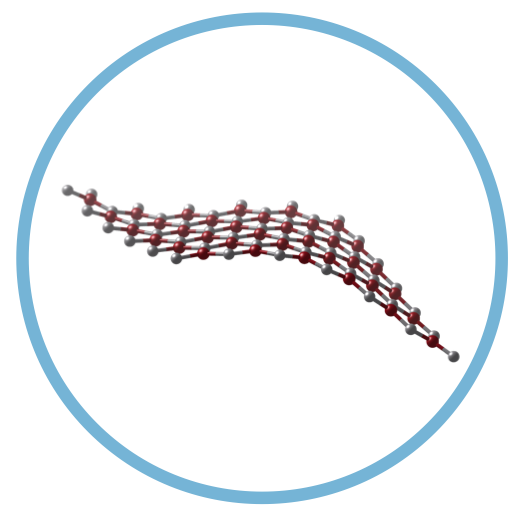
Transport in Disordered 2D Materials
Low dimensional materials have generated significant excitement in recent years due to the exotic properties they exhibit. Perhaps most well known is graphene, which is an atomically thin arrangement of carbon atoms. These systems have superior electrical conductivity properties, for example, and could play an integral role in next-generation electronic devices. Are the transition-metal dichalcogenides. Utilizing state-of-the-art imaging, we examine how experimentally observed disorder impacts the transport properties in materials from first principles DFT.
Publications: https://www.nature.com/articles/s41563-020-0636-5
Topological Invariants of Chiral Floquet Phases
Among the growing class of topological matter, by far the most common are those that are classified by equilibrium topological phases. However, there also exists a more exotic and less familiar class of non-equilibrium topological phases. These occur, for example, in Floquet system, and they exhibit behaviour that would otherwise be impossible in a static setting. One such example are chiral Floquet phases, which possess unidirectional edge channels for quantum information. Of particular interest, we examine how the topological invariant of these systems can be reformulated in terms of entanglement entropies, which are physically more intuitive and experimentally more accessible.
Publications: https://link.aps.org/accepted/10.1103/PhysRevB.98.054309